Does IQ Change With Age? What Rises, Falls and Stays Put
Your IQ score is designed not to move after about age 20. Your abilities move a lot, in opposite directions at once. And a childhood score can shift 20 points before it settles.
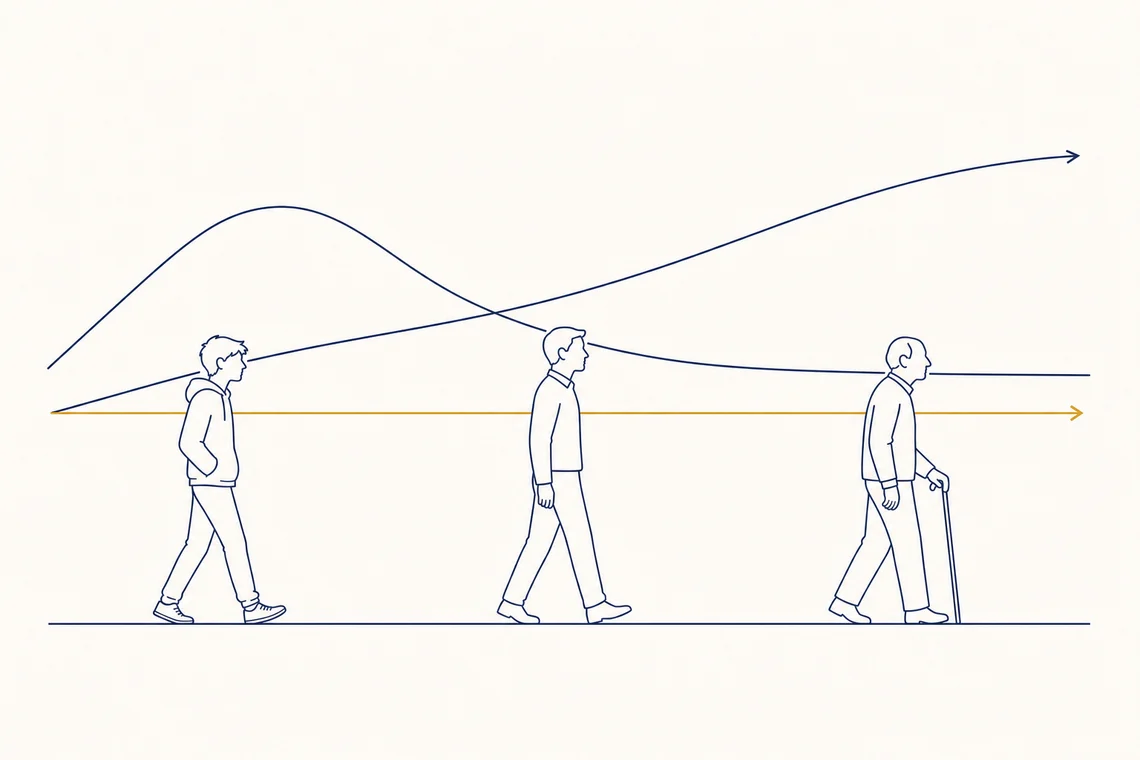
Does IQ change with age? Your IQ score mostly doesn't, once you're past about 20. The abilities underneath it change a great deal, and in opposite directions at the same time. And a score from childhood or your teens can move by 20 points or more before it settles.
Those are three different questions wearing the same label. Most answers to "does IQ change with age" blur them together, which is why you'll find one page saying IQ is fixed for life and the next saying it peaks at 25. Both are partly right. They're just talking about different things.
Three things people mean by "IQ" when they ask about age
The first is the score: the number a test prints out, where 100 is average. That number is adjusted for your age before you ever see it.
The second is raw ability: how fast you think, how many puzzles you solve, how many words you know. That's what scientists mean when they talk about peaks and declines. It's never adjusted for age.
The third is a childhood or teenage score. Children's tests work on the same scale as adult tests, but the thing they're measuring is still under construction. So those scores behave differently from adult ones, and deserve their own answer.
Keep the three apart and the whole topic gets simple.
Why your IQ score is built to stay flat after about 20
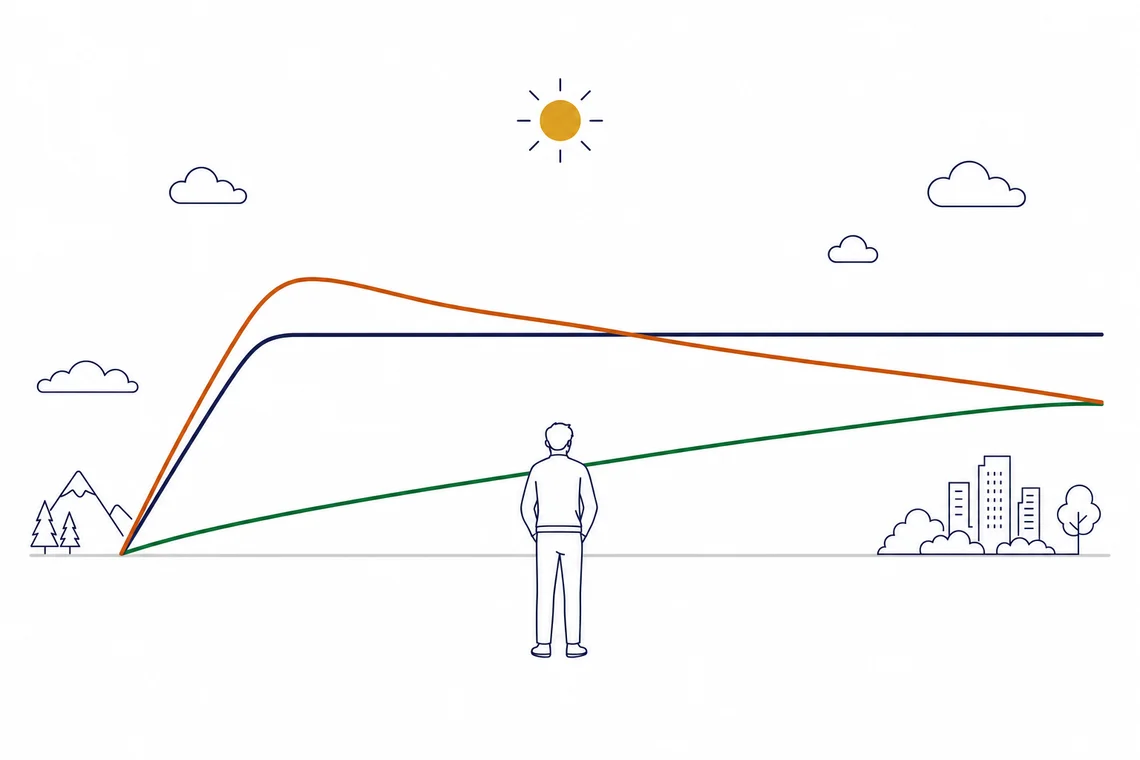
An IQ score isn't a count of right answers. It's a rank. The test compares your raw performance with people your own age, then converts that rank to a scale where 100 is the average for your age group.
The WAIS-IV, the most widely used adult test, was standardised on 2,200 Americans aged 16 to 90. Those people were split into 13 age groups: 16–17, 18–19, 20–24, 25–29, 30–34, 35–44 and so on up to 90. Each group gets its own conversion table from raw score to scaled score.
So a 70-year-old who solves fewer matrix puzzles than a 25-year-old can still score 100. Other 70-year-olds solve fewer puzzles too, and the table already knows that. The score strips age out on purpose.
That's the honest answer to "does IQ change with age" at the level of the score: it's designed not to. If your number at 45 matches your number at 22, it means you've held your place among your peers, not that nothing in your head has changed.
What peaks in your 20s: speed, memory and puzzle-solving
The abilities that age earliest are the ones most IQ tests lean on hardest. Psychologists call them fluid intelligence: solving a problem you've never seen before, without using stored knowledge.
A 2015 study in Psychological Science, by Joshua Hartshorne and Laura Germine, pooled results from 48,537 online participants with the Wechsler test norms. Raw processing speed peaked at about 18 or 19 and started falling straight away. Short-term memory kept improving until around 25, held steady, then began dropping around 35.
Matrix puzzles, the grids of shapes where you pick the missing piece, follow the same pattern. In the standardisation data for the WASI-II, a short Wechsler test, Matrix Reasoning scores peaked between ages 20 and 29 and then fell consistently. Block Design, a hands-on spatial task, peaked between 17 and 44.
Those matrix puzzles are the backbone of most online IQ tests. So the skill you just used is the one that ages first. The age tables absorb that, which is the whole reason they exist.
What keeps rising into your 40s, 60s and beyond
Crystallized intelligence is the other half: vocabulary, general knowledge, and the judgment that comes from having seen a lot of situations. It doesn't peak in your 20s. It isn't close.
In the Hartshorne and Germine data, vocabulary peaked in the late 60s or early 70s. The older Wechsler norms had put the peak in the late 40s; the authors suggested more schooling and more reading-heavy jobs had pushed it later. Reading emotions from other people's eyes peaked in the 40s and 50s.
A 2025 study in PNAS, led by the economist Eric Hanushek, tested German adults twice several years apart rather than comparing different people. It found literacy peaking at about 46 and numeracy at about 41, with modest declines after that. So the exact peak for knowledge-based skills is contested: mid-40s by one method, late 60s by another. The direction isn't contested. Knowledge peaks decades after speed.
The Seattle Longitudinal Study, running since 1956 and following more than 6,000 adults, adds the long view. Its lead researcher, K. Warner Schaie, concluded that reliably replicable average declines in mental abilities do not show up before age 60. By 74 every ability shows some decline on average. Number skills and speed went first; verbal ability held on longest.
Does decline start at 25 or at 60? Why researchers disagree
You'll see both numbers quoted as fact. They come from two ways of measuring, and each has a flaw.
Timothy Salthouse compares people of different ages tested once. In a 2009 paper in Neurobiology of Aging, he argued that some aspects of decline begin in healthy, educated adults in their 20s and 30s. His earlier work with David Schroeder put the slide at about 0.02 standard deviations a year between 20 and 50 for memory and reasoning. That's roughly three IQ points a decade, if nobody corrected for age.
Schaie replied in the same journal issue. His objection: a 25-year-old and a 65-year-old tested in the same year grew up in different worlds, with different schooling. Comparing them measures the gap between generations, not ageing. Follow the same people instead and the early decline largely vanishes.
Salthouse's counter is that following the same people has its own problem. Everyone improves with practice on a repeated test, which hides real decline. The truth probably sits between the two camps. Either way, none of it reaches your score, because the norms were built from people the same age as you.
Why a teenager's IQ score can swing 20 points
A 2011 study in Nature, led by Sue Ramsden at University College London, tested 33 teenagers at an average age of 14 and again about three and a half years later. Nobody knew a second test was coming, so nobody prepared.
The group average barely moved, from 112 to 113. Individuals moved a lot. Full-scale scores shifted anywhere from 18 points down to 21 points up. Verbal scores ranged from 20 down to 23 up. Roughly one in five teenagers moved by 15 points or more in verbal IQ, which is a full standard deviation.
The study also scanned their brains both times. The teenagers whose verbal scores rose showed matching increases in grey matter in a speech-related region of the left motor cortex. Non-verbal gains matched changes in the cerebellum. That matters because it means the swings weren't just measurement noise. Something real was still being built.
Younger children swing even more. The Fels Longitudinal Study, reported by Robert McCall and colleagues in 1973, followed middle-class children from two and a half to 17. Between their highest and lowest tests, they changed by an average of 28.5 IQ points. One in seven moved more than 40.
How well a score at 11 predicts a score at 77
From about age seven, scores start to stick. A 2025 PNAS study from the Colorado Longitudinal Twin Study followed 1,098 people from infancy to around age 29. Measures taken in infancy explained only about 13 percent of the differences in adult scores. From age seven onward, scores correlated with later scores at 0.72 to 0.86.
A 2024 meta-analysis in Psychological Bulletin, covering 205 studies and 87,408 people, found the same shape. Average stability across all ages was 0.77. It was lowest in preschool children and rose steadily from there.
The longest follow-up on record is Scottish. Ian Deary's team tracked down 101 people who had sat the Moray House Test at age 11 in 1932 and gave them the identical test at 77. The correlation was 0.63, or 0.73 after correcting for the narrower range of the survivors. Another 106 people from the same cohort sat it again at 90: the correlation was 0.54, or 0.67 corrected.
A correlation of 0.63 means your rank at 11 accounts for roughly 40 percent of where you stand at 77. That's a strong link by the standards of anything measured 66 years apart. It also leaves most of the variation to everything that happened in between.
What a test at 15 versus 45 is actually comparing
Put a 15-year-old and a 45-year-old in front of the same puzzle and the 15-year-old will probably be faster. That tells you nothing about who has the higher IQ, because neither of them is being compared with the other.
At 15 you're scored against other 15-year-olds, on a children's version of the test. Your speed is near its lifetime peak. Your vocabulary is decades from its peak. Your score says: here's where I rank among people born the same year as me.
At 45 you're scored against other adults around your age, on an adult test. Your raw matrix performance is probably lower than it was at 25. Your raw vocabulary is probably higher. Your scaled score can come out identical to the one you got at 15, because the tables have already accounted for both shifts.
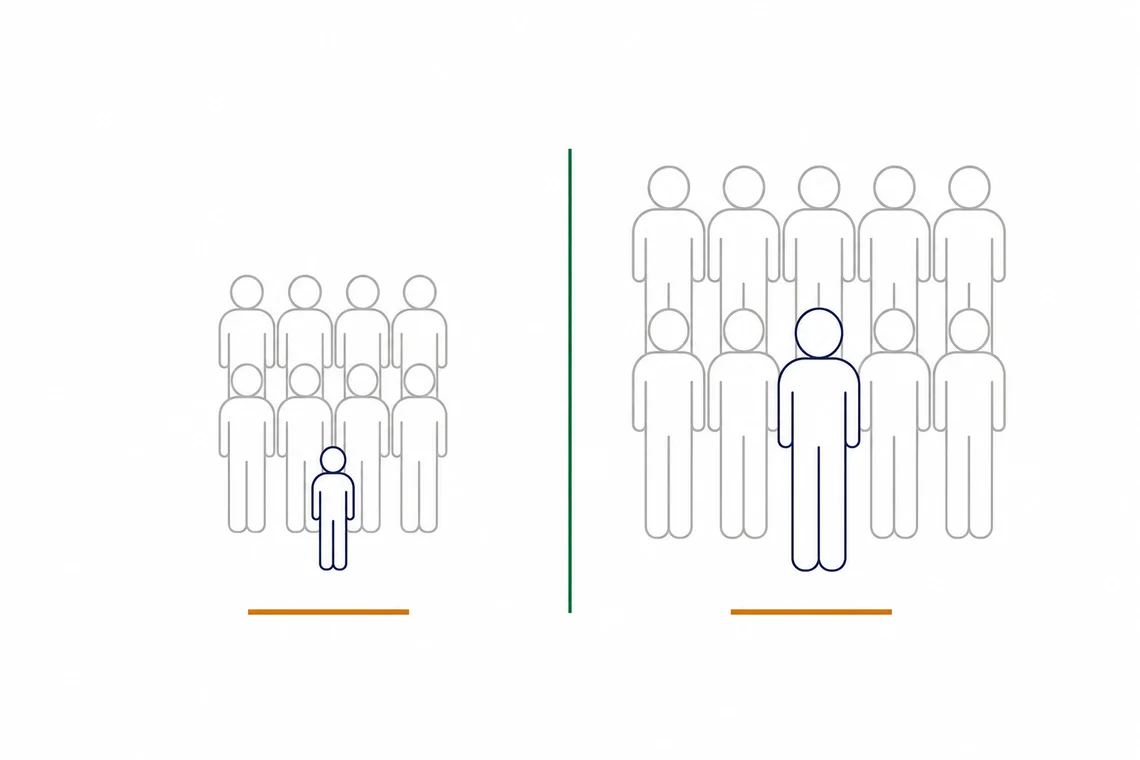
There's one more thing being compared: the year the norms were made. Raw scores rose through the 20th century, a trend known as the Flynn effect. James Flynn found a 13.8-point rise in the United States between 1932 and 1978, about three points a decade. A 2018 study of Norwegian military conscripts found the trend reversed for men born after 1975. So a test normed in 1990 and a test normed in 2015 set slightly different bars for "average". Two scores of 100, 30 years apart, are each saying "average for my age, against the people tested when this version was built."
What this means when you read your own score
If your score at 40 matches your score at 20, you didn't stay the same. You got slower at new puzzles and better at nearly everything else, and the test weighed those against your peers and called it a draw. That's the score doing its job.
If you're comparing against a number from childhood, don't. Before about seven it's close to a guess, and even in the mid-teens one person in five moves 15 points in a few years.
And if you're wondering whether the decline researchers argue about has reached you, remember what they argue about. It's whether raw speed starts slipping at 25 or at 60. It's not whether the rank that your score reports has moved. For most adults, across most of adult life, it hasn't.
36 pattern questions, scored on the standard scale where 100 is average and most people fall between 85 and 115.
Start IQ test →- No account to create
- About 20 minutes
- Works on any device