IQ Test vs Cognitive Test: They Are Not the Same Thing
A doctor's ten-minute memory check, a hiring test with a brutal time limit and a full IQ battery all get called 'cognitive tests'. They answer three different questions — and only one produces an IQ.
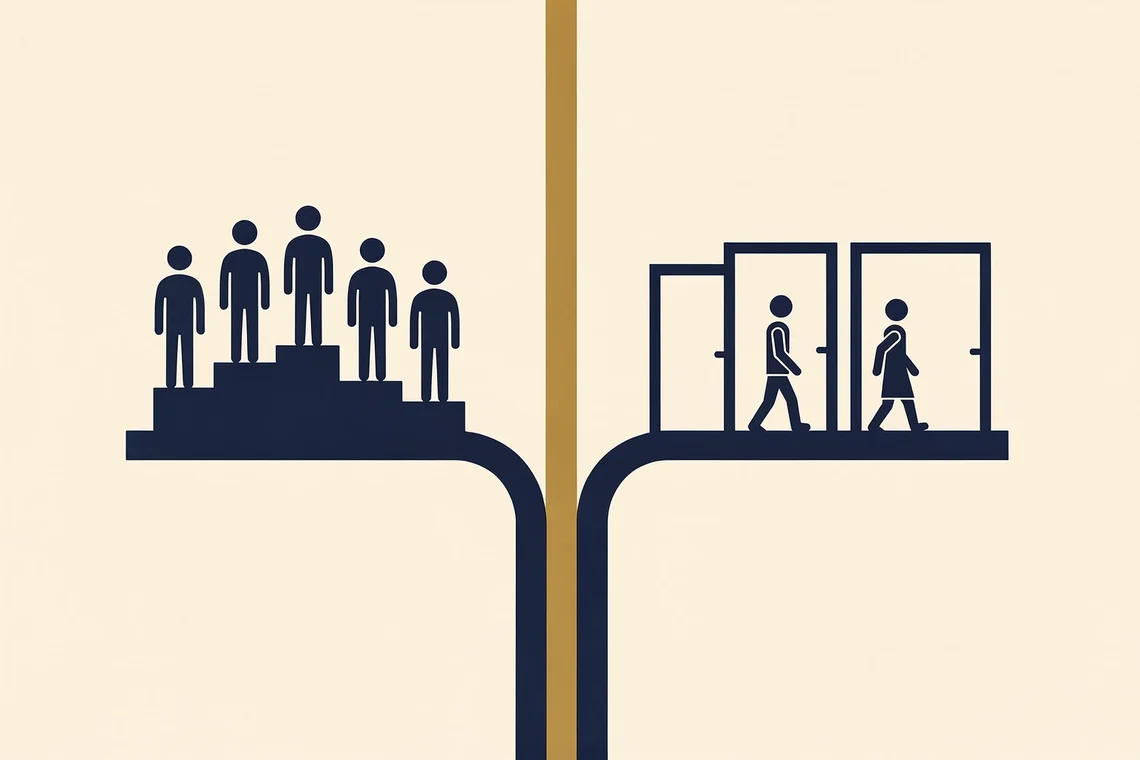
An IQ test measures general mental ability and places you on a scale where 100 is the average for your age group. A cognitive test usually means something else entirely: either a short medical screening that looks for signs of impairment, or a timed aptitude test used in hiring. That is the real difference between an IQ test and a cognitive test — different purposes, different comparison groups, different score meanings. Only the IQ test produces an IQ.
The confusion is understandable. All three get called cognitive tests, and all three involve memory, reasoning and mental effort. But they answer three different questions, and mixing them up leads people to conclusions their score cannot support.
Why the same word covers three completely different tests
"Cognitive" just means "related to thinking", so almost any mental test can wear the label. What separates the three types is the question each one was built to answer.
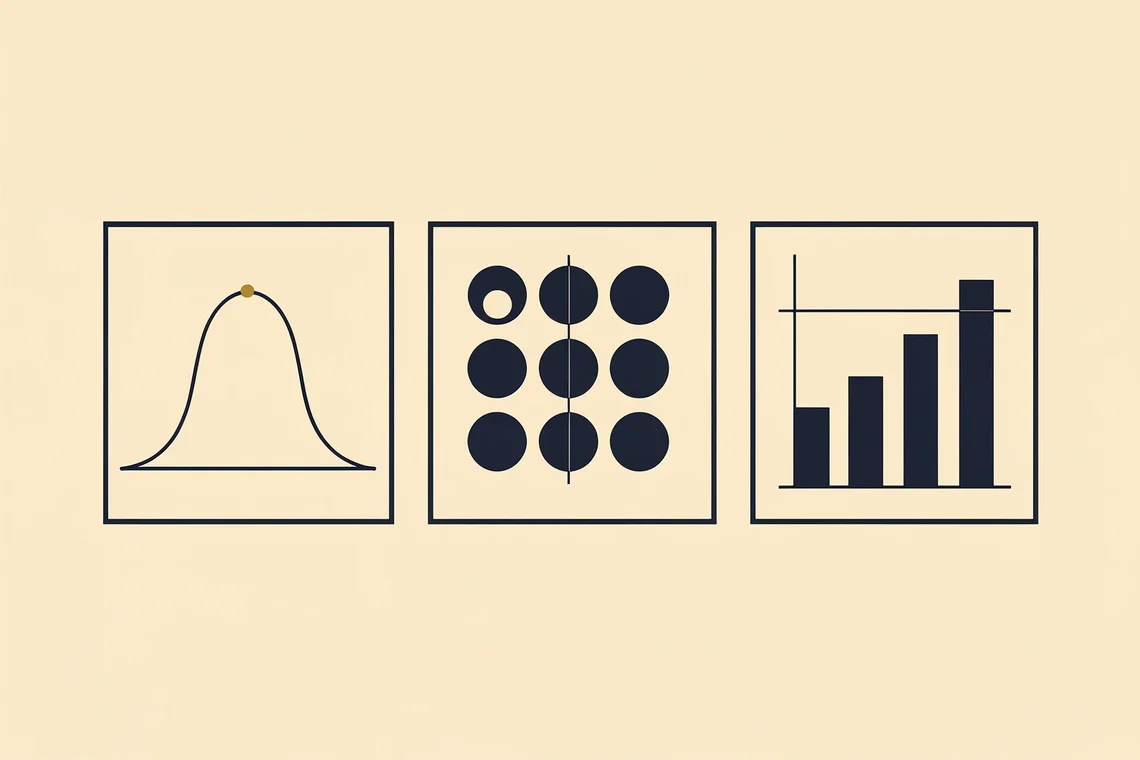
- A psychometric IQ battery asks: where does this person's general ability rank among people their age?
- A medical cognitive screen asks: is there a warning sign that something has gone wrong with this person's thinking?
- A workplace aptitude test asks: how does this applicant compare with other applicants, and can they handle this job?
The tasks can look similar on the surface. Recalling words, solving puzzles, working against a clock. But a doctor asking you to remember five words is not measuring your intelligence. An employer timing you through fifty logic questions is not checking you for dementia. The score each test spits out only makes sense inside its own question.
What a real IQ test involves — and why it takes about an hour
The standard adult IQ test in the United States is the Wechsler Adult Intelligence Scale. Its fifth edition, the WAIS-5, was published by Pearson in 2024 and covers ages 16 to 90. Getting a Full Scale IQ takes about 45 minutes of one-on-one testing; the full set of index scores, covering areas like working memory, fluid reasoning and processing speed, takes about an hour. Children aged 6 to 16 get the WISC-V instead.
You cannot simply buy one. Pearson restricts the WAIS to its highest qualification tier, which requires a doctorate in psychology or a related field, a professional license, or membership in a body such as the American Psychological Association. That is why a professionally administered IQ assessment costs real money: US practices list standalone IQ testing at roughly $550 to $1,200, and broader psychological evaluations run higher still.
The expensive part is the norming. Your raw performance is converted into a score by comparing it with a standardization sample built to mirror the US population. The previous edition, the WAIS-IV, was normed on 2,200 people aged 16 to 90; the WAIS-5 norms were collected in 2023 and 2024 and matched to the census on five demographic variables. Against that sample, scores are scaled so the average is 100 and the standard deviation — the typical spread around that average — is 15. That construction is what makes a number an IQ.
What a medical cognitive screening test actually checks
If a doctor gave you a "cognitive test", it was almost certainly a screening tool. The most common ones are short and blunt by design.
The Montreal Cognitive Assessment, or MoCA, introduced in 2005, takes about ten minutes and is scored out of 30. The test's own guidance treats 26 and above as normal and 18 to 25 as the mild impairment range. It samples memory, attention, language, orientation and abstract thinking with quick tasks such as recalling a short word list. The older Mini-Mental State Examination, from 1975, is also scored out of 30, with scores below about 24 raising concern. The Mini-Cog takes three minutes: recall three words, draw a clock. The SLUMS exam runs 11 questions in about seven minutes.
None of these diagnose anything. The Alzheimer's Association is explicit that no single test can determine whether someone has dementia; a low screening score is a signal to do a full workup, with medical history, neurological exams and often brain imaging. And none of them produce anything like an IQ. The scores are raw points against a fixed cutoff, not a ranking against the population.
Why a perfect score on a cognitive screen says nothing about your IQ
Here is the part most comparison articles miss. A cognitive screen is deliberately easy, because it is a smoke alarm, not a measuring tape. A healthy adult is expected to score at or near the ceiling. The MoCA was created precisely because the MMSE had a ceiling problem — too many people with early impairment still scored in the normal range.
So a 30 out of 30 on the MoCA does not mean you are gifted. It means the alarm did not go off. The test has no headroom to distinguish an average scorer from a brilliant one, and it is not trying to.
The traffic also runs the other way. A 2013 study in the Journal of Geriatric Psychiatry and Neurology found that a person's estimated lifelong IQ predicted between 8 and 33 percent of the variation in MMSE and MoCA scores, in both healthy and impaired groups. That is exactly what a screening tool does not want: it means someone who started high can lose real ground and still clear the cutoff, while someone who started lower can trip the alarm with nothing wrong. The MoCA's official scoring even adds one point for people with 12 or fewer years of education — a correction that tells you the test is fighting background differences, not measuring them.
One more limit worth knowing: the MoCA was validated for people aged 55 to 85. If you are 35 and someone hands you one, it is being used outside the population it was built for.
How hiring tests like the Wonderlic and CCAT differ from both
The third thing Americans call a cognitive test is the pre-employment assessment. The Wonderlic gives you 50 questions in 12 minutes. The Criteria Cognitive Aptitude Test, or CCAT, gives you 50 questions in 15 minutes, and the publisher itself notes that very few people finish. That time pressure is the point. These are speeded tests, and speed under pressure is part of what they measure.
Their norms are nothing like an IQ test's. The CCAT was normed on 985 working adults drawn from more than 50 companies — an applicant-style pool, not a census-matched national sample, and not broken down by age. Your result comes back as a raw score and a percentile against that pool; the average raw score in the norm group was about 24 out of 50. Wonderlic goes further and benchmarks you against a profile for the specific job, built partly from the Department of Labor's O*NET database. The same performance can look strong for one role and weak for another.
Employers use these tests because general mental ability predicts job performance unusually well. A famous 1998 meta-analysis by Schmidt and Hunter put the validity at about.51, the strongest of any single hiring method. A 2022 re-analysis by Sackett and colleagues argued that figure was inflated by a statistical correction and put it nearer.31 — a live dispute, but even the lower figure keeps cognitive ability among the best predictors available. There is a legal layer too: since the Supreme Court's 1971 Griggs v. Duke Power ruling, employment tests that screen out protected groups at different rates must be shown to be job-related. That is one reason publishers talk about job fit rather than intelligence.
The twist is that these tests do tap the same underlying ability an IQ test measures. Criteria's own sample score report describes the CCAT as measuring "cognitive aptitude, or general intelligence". What they do not give you is an IQ-scale score, because their comparison group cannot support one.
The difference between an IQ test and a cognitive test at a glance
| Psychometric IQ test | Medical cognitive screen | Workplace aptitude test | |
|---|---|---|---|
| Examples | WAIS-5, WISC-V | MoCA, MMSE, Mini-Cog, SLUMS | Wonderlic, CCAT |
| Built to answer | Where do you rank in general ability? | Is something going wrong? | Can you handle this job? |
| Who gives it | Licensed psychologist, one-on-one | Doctor, nurse or clinic staff | Employer, usually online |
| Time | About 45–60+ minutes | 3–10 minutes | 12–15 minutes, strictly timed |
| Compared against | Age-based norms from a census-matched national sample | A fixed clinical cutoff | Applicant pools and job benchmarks |
| Score looks like | IQ: mean 100, standard deviation 15 | Points out of 30 versus a cutoff | Raw score plus percentile |
| Gives you an IQ? | Yes | No | No |
Which test were you actually sent to?
Most people searching this question just took something and want to know what it was. Three quick tells.
- It happened at a doctor's office, took about ten minutes, and involved recalling words or drawing a clock. That was a screening test such as the MoCA or Mini-Cog. Your score says whether follow-up is needed. It says nothing about your intelligence, in either direction.
- It was online, part of a job application, with a hard time limit and around 50 fast questions. That was an aptitude test like the CCAT or Wonderlic. Your result is a percentile against other test-takers and a benchmark for that role — not an IQ, and not portable to any other context.
- It was one-on-one with a psychologist, lasted an hour or more, mixed verbal and visual tasks, and the report arrived later. That was a genuine IQ battery, and its Full Scale score is the only number in this article that means IQ.
If a website or an employer handed you a number and called it your IQ without an age-normed, professionally administered battery behind it, treat the label with suspicion.
Why only one of these can give you an IQ score
Strip everything else away and the difference is the comparison group. An IQ of 115 means one thing: you scored one standard deviation above the average of a representative sample of people your age. That claim is only possible because someone spent years testing thousands of people to build that sample.
A 27 on the MoCA means you cleared a cutoff designed to catch decline. A 75th percentile on the CCAT means you beat three quarters of a pool of job applicants. Both are useful answers to their own questions. Neither can be converted into an IQ, because neither test ever asked the question an IQ answers. The tests are not rivals or substitutes — they are three different instruments that happen to share a word.
36 pattern questions, scored on the standard scale where 100 is average and most people fall between 85 and 115.
Start IQ test →- No account to create
- About 20 minutes
- Works on any device